
Natural Hair Care Routine: A Weekly Rhythm That Fits Real Life
A natural hair care routine is not a shelf of matching bottles. It is a rhythm: one proper wash day, a few small habits through the week, and protection while you sleep. When that rhythm matches your texture and your calendar, your hair stops feeling like a second job.
The rhythm below works for waves, curls, and coils alike. The steps stay in the same order for everybody. What changes is how often you repeat them and how rich your products are, and that part gets decided by your hair, not by a chart.

Table of Contents
Start With Your Texture, Not a Stranger’s Shelf
Two heads of natural hair can thrive on opposite routines. Loose waves flatten under heavy butters, while tight coils drink up rich creams and still ask for more. How easily your strands soak up water, and how well they hold it, shapes your needs more than any curl chart does.
Before copying anyone’s lineup, watch your own hair for two wash days. Hair that feels dry again by day two needs moisture sealed in better. Hair that falls flat and limp usually needs lighter layers, not another product on top.

Wash Day Runs in One Simple Order
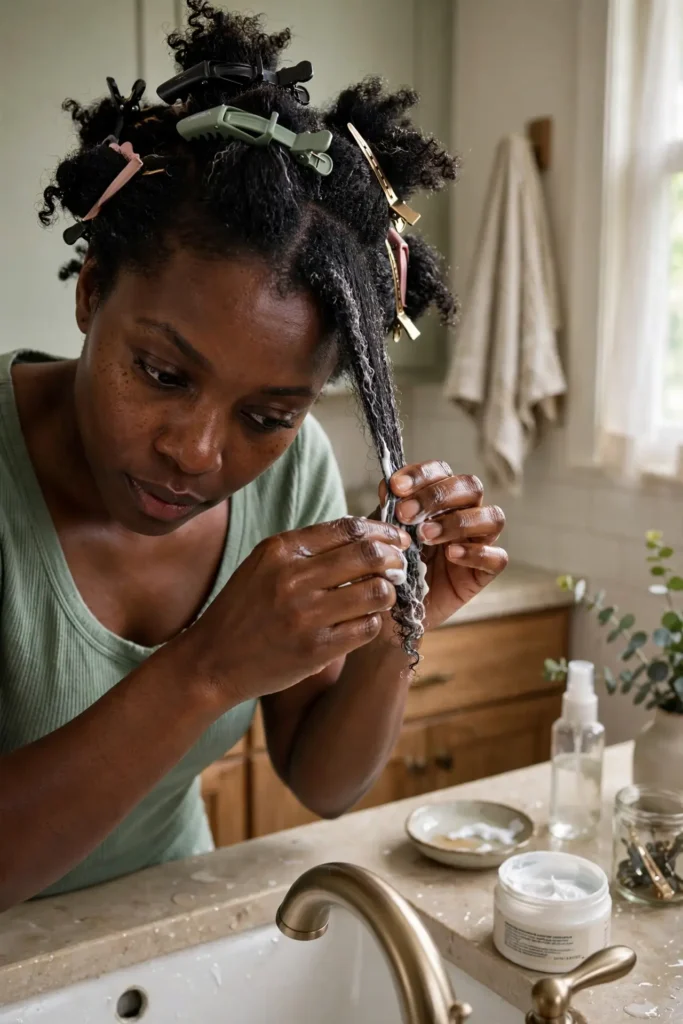
Wash day follows a set order, and the order does half the work for you. Detangle first, then cleanse the scalp, condition the lengths, deep condition, and finish by moisturizing and styling. Jumping around is how steps get skipped and ends get forgotten.
That single pass covers most heads. If your coils are tight, though, they reward the slow and gentle version of every step, and our 4c natural hair care guide walks through wash day strand by strand.
How Often Each Step Really Happens
Most natural hair does well with a wash day every week or every two weeks. Deep conditioning rides along with every wash instead of waiting for a special occasion. A clarifying wash belongs somewhere in the month as well, for the days when hair feels coated and products stop behaving.
Between wash days, plan on two or three quick moisture refreshes and a trim roughly every three to four months. That spacing is the backbone of a natural hair care routine: frequent small care, and only rare big resets.

Mornings Take Five Minutes
Morning care is mostly restraint. Lift the roots with your fingertips, shape everything with your palms, and mist only the spots that look thirsty. Once curls and coils have dried, hands off, because every extra touch pulls the pattern apart and stirs up frizz.
A style set properly on wash day usually just needs waking up. A light spritz of water with a little leave-in brings most styles back without rebuilding them from nothing.

What You Do at Night Decides the Morning
More routines unravel at night than in the shower. Hair left loose loses moisture to the pillowcase for eight hours and wakes up tangled and dull. A satin bonnet or a satin pillowcase removes most of that friction while you sleep.
Length picks the method. Short hair rests fine under a bonnet on its own. Longer hair keeps better gathered up, in a pineapple, two loose braids, or chunky twists, so the ends stay off the pillow and out from under your shoulders.

The Routine While Your Hair Is in a Protective Style
An install does not pause the routine. It shrinks it. Your own hair under braids, twists, or a wig still collects sweat and buildup, so plan a gentle scalp cleanse every week or two, plus a light mist of leave-in along the parts you can reach.
What happens between installs counts just as much: one full wash day and a few loose days before the next style goes in. Choosing the style itself matters too, and our simple protective hairstyles for natural hair picks keep the tension low.

Gym Hair Without a Full Wash Every Time
Daily training does not demand daily wash days. Sweat is mostly salt and water, so a scalp rinse or a gentle co-wash handles most sessions on its own. Keep the full cleanse on its scheduled day unless your scalp feels genuinely uncomfortable.
Tie your hair up off your neck before you train, and let it dry fully before you restyle or cover it. Damp roots sealed under a style all afternoon are where itch and odor get their start. During a heavy training block, one proper wash a week keeps the scalp honest.

Busy Weeks Get the Minimum Version
Every routine needs a floor, the stripped-down version that survives your worst week. For natural hair that floor has four moves: cleanse, deep condition, moisturize, and protect it at night. Those four keep hair healthy when there is no time for a single extra.
What gets cut in a busy week is decoration: marathon styling sessions, elaborate twist-outs, bonus treatments. What never gets cut is the base. Two plain braids worn for days beat a flawless style built on skipped wash days.

The Seasons Ask for Small Changes
Summer asks for a lighter hand. Humidity swells hair, and heavy creams turn sticky in the heat, so thinner layers carry most heads through. Rinsing with plain water before a swim also helps, because hair that is already wet soaks up far less pool or sea water.
Winter turns the problem around. Indoor heating pulls moisture out of the air and out of your strands, so richer creams, a heavier seal on the ends, and a deep condition that never gets skipped see most people through the cold months.

Signs the Routine Needs Rewriting
Your hair reports back through results. Hair that feels dry again the morning after wash day is asking for more moisture or a better seal. Ends that snap during gentle detangling are asking for less tension, a trim, or a fresh look at protein. Hair that hangs limp and coated usually wants a clarifying wash, not another mask.
Adjust one thing at a time, then watch it across two or three wash days before adjusting anything else. A scalp that stays itchy, flaky, or sore through every adjustment is not a product problem, though. That one belongs to a dermatologist, and the American Academy of Dermatology’s hair care guidance explains when a scalp issue needs that visit.

Quick Answers
How often should I wash natural hair?
Once a week or once every two weeks suits most people. Looser textures usually sit at the weekly end, while tight coils and hair resting in protective styles can stretch toward two weeks if the scalp stays calm.
Do I need different products for each season?
Usually not. Most people keep the same products and change the amounts: lighter layers and extra rinses in summer, richer sealing and no skipped deep conditions in winter. Your shelf can stay small.
How long before a new routine shows results?
Give it three or four wash days. Hair answers slowly, and judging after a single wash leads to endless switching. A softer feel, fewer tangles, and less breakage caught in the brush are the first honest signs.
Can one routine cover two textures on the same head?
Yes, and most heads carry more than one texture anyway. Keep the same wash day order for everything, then adjust by section: looser areas get lighter product, and tighter coils get more moisture and more patience.
How do I restart after a few weeks of neglect?
Start with one full wash day: detangle slowly, clarify if your hair feels coated, deep condition, and style it simply. One honest reset puts you back on the rhythm. Trying to make up for lost time with five treatments in one day just overwhelms your hair.

That is the whole point of a natural hair care routine: not perfection, just a rhythm you can keep on your busiest week and your laziest one. Build the wash day, protect the nights, and let small habits do the quiet work.





Pingback: Curly Hair Care That Works With Your Curls, Not Against Them
Pingback: Wavy Hair Care For Waves That Stay Soft, Not Flat
Pingback: Indian Hair Care: Warm Oil, Champi Massage And Herbs That Work
Pingback: Hair Care Products: How To Choose By Job, Label And Texture